

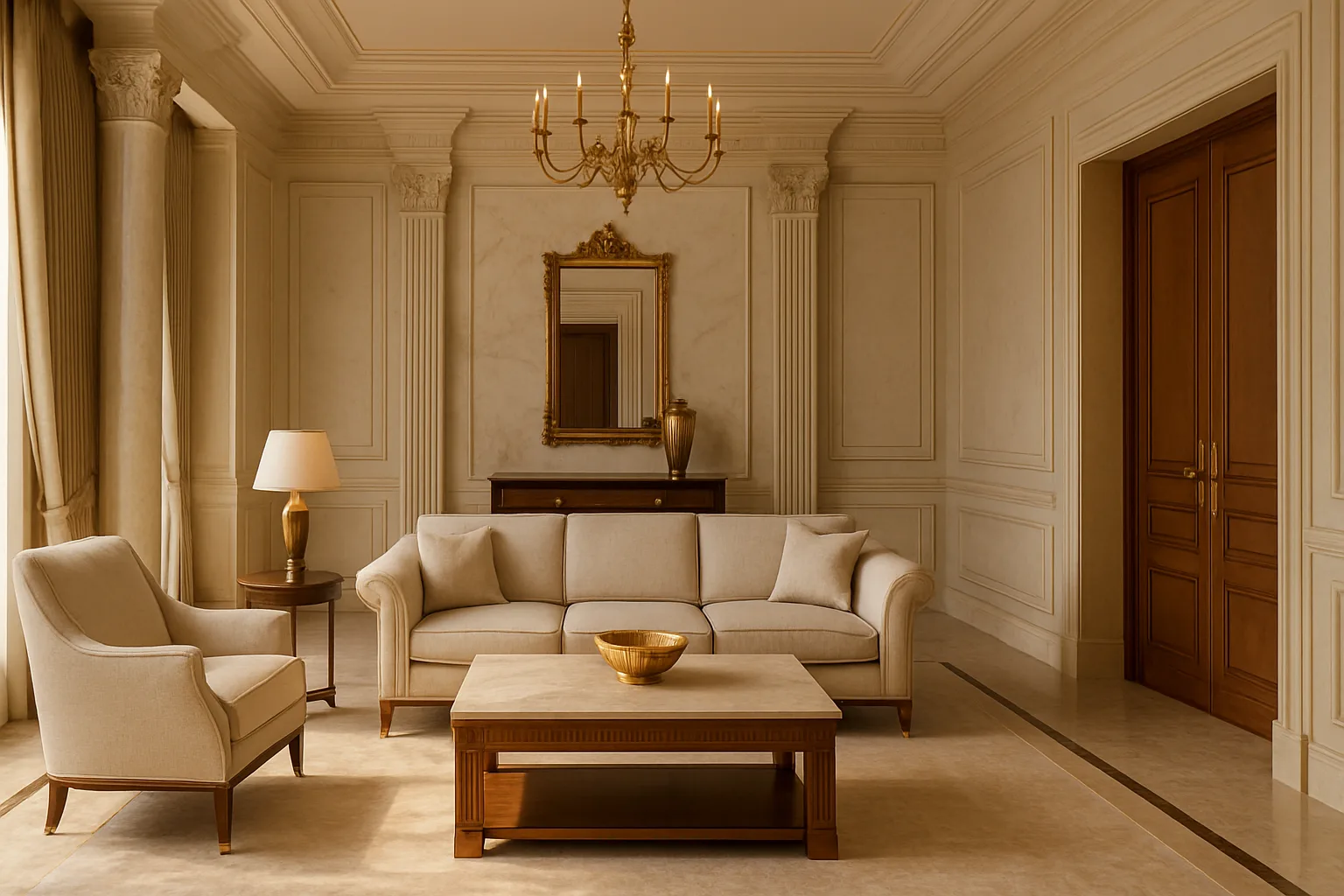
Discover how neoclassical interior design brings timeless European elegance to Saudi villas, blending classical details with modern Arabic proportions.
What Is Neoclassical Interior Design and Why Is It Perfect for Saudi Villas?
Neoclassical interior design is a refined architectural style that draws from classical Greek and Roman principles—symmetry, proportion, and understated ornamentation—reinterpreted for contemporary living. For Saudi villas, it offers a harmonious blend of European elegance and the grandeur expected in local homes, without the heaviness of baroque or rococo excess. The style emphasizes clean lines, balanced layouts, and carefully scaled details such as cornices, panel moulding, and fluted columns, creating spaces that feel both majestic and welcoming.
In Saudi Arabia, where hospitality and family gatherings are central, neoclassical design provides the perfect backdrop for a majlis that impresses guests while remaining comfortable for daily life. The style’s focus on proportion ensures that large rooms—common in Saudi villas—don’t feel cavernous; instead, they feel intimate and curated. By incorporating local materials like warm-toned marble and rich woods, neoclassical interiors can be adapted to the Saudi climate and cultural context, making them feel authentically rooted rather than imported.
Moreover, neoclassical design aligns with the growing preference for quiet luxury in the Kingdom. Rather than ostentatious displays of wealth, it speaks through impeccable craftsmanship, timeless materials, and a restrained color palette. This resonates with homeowners in Khobar, Riyadh, and beyond who seek spaces that are elegant yet understated, reflecting a sophisticated lifestyle without shouting for attention.
How Do You Adapt Neoclassical Details to Saudi Villa Proportions?
Saudi villas often feature high ceilings and expansive rooms, which are ideal for neoclassical detailing but require careful scaling to avoid a cold, museum-like feel. The key is to adjust classical proportions to suit the local architectural context. For instance, cornices should be sized relative to ceiling height: a general rule is that the cornice depth should be about 1/18th of the ceiling height. In a room with 4-meter ceilings, a cornice of approximately 22 cm works well, providing elegance without overwhelming the space.
Panel moulding on walls should be proportioned to the wall’s dimensions. A common guideline is to divide the wall into sections, with panel widths ranging from 60 to 90 cm, depending on the room’s size. In a large majlis, wider panels (around 90 cm) can create a sense of grandeur, while narrower panels (60 cm) suit more intimate spaces like a formal dining room. The depth of the moulding itself should be subtle—typically 2-3 cm—to maintain a refined look.
Fluted columns, a hallmark of neoclassical design, can be incorporated as decorative elements or structural supports. In Saudi villas, they are often used to frame entryways or define zones within open-plan areas. The spacing between flutes should be consistent, and the column’s diameter should be proportionate to its height—usually a 1:8 ratio. For a 3-meter column, a diameter of about 37.5 cm is appropriate. These columns can be finished in plaster, stone, or wood, depending on the desired effect.
Parquet borders are another classical detail that can be adapted. In Saudi homes, where marble and stone flooring are common, a parquet border in the majlis or dining room can add warmth and definition. The border width should be about 10-15% of the room’s width; for a 6-meter-wide room, a border of 60-90 cm is suitable. This creates a frame that draws the eye and adds a layer of craftsmanship.
What Are the Key Elements of Neoclassical Interior Design for a Saudi Majlis?
The majlis is the heart of a Saudi home, and neoclassical design can elevate it into a space of refined hospitality. Start with the ceiling: a central medallion or a subtle tray ceiling with concealed lighting adds depth without clutter. Cornices should be present but not overly ornate—think simple dentil or egg-and-dart patterns rather than elaborate scrolls. Lighting is crucial; a combination of a statement chandelier (crystal or brass) and wall sconces with fabric shades provides layered illumination that flatters both architecture and guests.
Walls in a neoclassical majlis often feature panel moulding painted in a soft, neutral tone—think warm greige, ivory, or a muted sage. These panels can be left empty or adorned with subtle artwork or mirrors. For a touch of luxury, consider applying a metallic glaze or a subtle wallpaper with a damask pattern inside the panels. The lower portion of the wall can be clad in stone or wood wainscoting for durability and visual weight.
Seating in a neoclassical majlis should be comfortable yet formal. Low sofas and armchairs with carved wooden frames and upholstery in rich fabrics like velvet or brocade work well. Arrange them in a U-shape to encourage conversation, with side tables for coffee and dates. A large, intricately patterned rug—perhaps a Persian or a modern interpretation—anchors the space. Color palette: deep blues, emerald greens, or burgundy paired with gold or brass accents create a regal atmosphere, while lighter tones like cream and beige keep it airy.
Accessories should be curated: a pair of classical vases, a gilded mirror, or a marble console table. Avoid clutter; neoclassical design thrives on balance and negative space. In Saudi Arabia, where majlis gatherings can be large, ensure there is ample circulation space and that furniture can be rearranged easily for different occasions.
How to Use Color and Materials in Neoclassical Saudi Interiors?
The neoclassical palette is typically understated, drawing from natural stones, woods, and metals. In Saudi villas, where the climate is hot, lighter colors can help reflect heat and create a sense of coolness. Consider a base of warm whites, creams, and soft greys for walls and ceilings. These can be accented with deeper tones like navy, forest green, or aubergine in upholstery, drapery, or artwork. Metallic accents in brass, bronze, or gold add warmth and a touch of opulence.
Materials should be chosen for both beauty and durability. Marble is a staple—opt for local varieties like Saudi marble or imported Italian Carrara or Calacatta for flooring, countertops, and fireplace surrounds. Wood species such as oak, walnut, or mahogany are ideal for parquet floors, paneling, and furniture. In humid coastal areas like Khobar, ensure wood is properly sealed to prevent warping. For upholstery, consider mohair, velvet, or high-quality leather; these fabrics are luxurious and wear well.
Lighting fixtures play a critical role. Chandeliers with crystal or glass elements, wall sconces with fabric or metal shades, and table lamps with classical bases (e.g., column-shaped) are all appropriate. Use warm white bulbs (2700K-3000K) to create a cozy glow. In larger spaces, layer lighting with dimmers to adjust the mood.
Textiles such as silk, wool, and linen add texture. Curtains should be floor-length and lined for weight; consider a valance or swag for a classical touch. Rugs can be hand-knotted wool or silk, with patterns inspired by classical motifs or subtle geometric designs. In Saudi homes, where floors are often stone, rugs add warmth and reduce echo.
How to Integrate Modern Arabic Proportions with Neoclassical Design?
Modern Arabic proportions often favor open, airy layouts with a focus on hospitality and privacy. Neoclassical design can complement this by providing architectural structure without closing off spaces. For example, use fluted columns or pilasters to delineate zones in an open-plan living area, rather than full walls. This maintains the flow while adding classical elegance.
In terms of scale, modern Arabic interiors tend to have lower furniture and a more relaxed seating height. Neoclassical furniture can be adapted by choosing pieces with lower backs and deeper seats, upholstered in performance fabrics that are easy to maintain. The majlis seating, for instance, can feature neoclassical carved frames but with cushions that are plush and low to the ground, aligning with local customs.
Ceiling treatments should respect local height preferences. While neoclassical design often celebrates high ceilings, modern Arabic homes sometimes have lower ceilings in certain areas. In such cases, use subtle cornices and avoid heavy chandeliers; instead, opt for recessed lighting and wall sconces to maintain the neoclassical feel without overwhelming the space.
Finally, incorporate Arabic calligraphy or geometric patterns subtly into neoclassical interiors. This can be done through custom wall panels, screen dividers, or even inlaid marble floors. The key is to blend the two languages seamlessly, creating a space that feels both globally classical and distinctly Saudi.
What Are Common Mistakes to Avoid in Neoclassical Saudi Villa Design?
One common mistake is over-ornamentation. Neoclassical design is about restraint; too many elaborate mouldings, gold leaf, or heavy drapery can make a space feel dated and oppressive. Stick to a few well-chosen details and let the architecture speak for itself.
Another pitfall is ignoring scale. In large Saudi villas, undersized furniture or thin mouldings can look lost. Ensure all elements are proportionate to the room’s dimensions. Conversely, in smaller rooms, oversized cornices or columns can feel cramped. Always consider the human scale.
Neglecting local climate and culture is another error. For instance, using delicate fabrics that fade in strong sunlight or materials that warp in humidity will lead to premature wear. Similarly, ignoring the need for privacy in majlis areas—such as large uncurtained windows—can make guests uncomfortable. Always incorporate practical solutions like UV-filtering window films and layered window treatments.
Lastly, don’t forget lighting. Neoclassical interiors rely on a balance of ambient, task, and accent lighting. A single chandelier is not enough; layer with sconces, table lamps, and floor lamps to create depth and flexibility. Dimmers are essential to adjust for different occasions.
How to Plan Your Neoclassical Villa Renovation in Saudi Arabia?
Begin by assessing your space and defining your goals. Are you renovating a single majlis or the entire villa? Determine which classical elements you want to incorporate—cornices, panel moulding, columns, parquet borders—and prioritize based on impact and budget. For a cohesive look, consider hiring an interior designer experienced in neoclassical and Saudi design.
Next, establish a realistic budget. Neoclassical detailing can be costly, especially if custom millwork and natural stone are involved. Allocate funds for high-quality materials and skilled craftsmen. In Saudi Arabia, local artisans can create custom plasterwork and woodwork, often at competitive prices. Get multiple quotes and check references.
Timing is crucial. In Saudi Arabia, the new-build and renovation season peaks in the cooler months (October to April). Plan your project to avoid delays due to extreme heat or Ramadan. Order materials well in advance, as imported items may take weeks to arrive.
Finally, consider future maintenance. Neoclassical interiors require regular dusting and occasional polishing of metals and stone. Choose materials that age gracefully and are easy to clean. With proper care, a neoclassical villa will remain elegant for generations.
◈ Key Takeaways
- ✦Neoclassical design blends classical European detailing with modern Arabic proportions, ideal for Saudi villas seeking timeless elegance.
- ✦Scale details like cornices, panel moulding, and columns to your ceiling height and room size to avoid a heavy or lost look.
- ✦Use a restrained color palette of warm neutrals with metallic accents, and choose durable materials suited to the Saudi climate.
- ✦Integrate Arabic cultural elements subtly, such as calligraphy or geometric patterns, to create a personalized, rooted design.
- ✦Plan your renovation during the cooler months and hire experienced craftsmen to ensure quality and timely completion.
Frequently Asked Questions
❓ What is neoclassical interior design?
Neoclassical interior design is a style that draws inspiration from the classical architecture of ancient Greece and Rome, characterized by symmetry, elegant proportions, and refined ornamentation. It often features columns, moldings, and decorative motifs like laurel wreaths and urns, combined with a neutral color palette. In Saudi villas, neoclassical interior design is adapted to create grand yet comfortable spaces that reflect cultural heritage and luxury.
❓ What is modern neoclassical interior design?
Modern neoclassical interior design blends the timeless elegance of neoclassical elements with contemporary clean lines and minimalism. It incorporates classical details such as cornices and pilasters but simplifies them, using modern materials and a lighter color scheme. This style is popular in Saudi villas for its ability to create sophisticated, uncluttered spaces that still feel regal and welcoming.
❓ What is neoclassical decor?
Neoclassical decor refers to the furnishings and accessories that embody the neoclassical style, including furniture with straight lines, tapered legs, and classical motifs like fluted columns and bronze accents. It often includes symmetrical arrangements, large mirrors, and crystal chandeliers. In Saudi Arabia, neoclassical decor is often enhanced with luxurious fabrics and gold accents to suit the opulent taste of villa interiors.
❓ How does neoclassical interior design differ from classical design?
Neoclassical interior design is a more refined and less ornate version of classical design, focusing on symmetry, proportion, and simplicity rather than the heavy embellishments of Baroque or Rococo styles. It incorporates classical elements but with a lighter touch, making it suitable for modern living. In Saudi villas, this translates to elegant spaces that are both grand and functional for contemporary lifestyles.
❓ Why is neoclassical interior design popular for Saudi villas?
Neoclassical interior design is popular for Saudi villas because it combines grandeur with comfort, aligning with the cultural appreciation for luxurious and hospitable living spaces. Its symmetrical layouts and elegant details create a sense of order and sophistication, while the use of neutral tones and rich fabrics adapts well to the Saudi climate and lifestyle. Additionally, it allows for customization to include traditional Arabic elements, making it a versatile choice for modern villas.
Ready to Transform Your Space?
Ready to transform your Saudi villa with the timeless elegance of neoclassical interior design? Contact SB Interior Design today for a consultation and let our experts craft a space that reflects your refined taste and cultural heritage.
SB Interior Design
Quiet Luxury Interior Design — Khobar, Saudi Arabia