

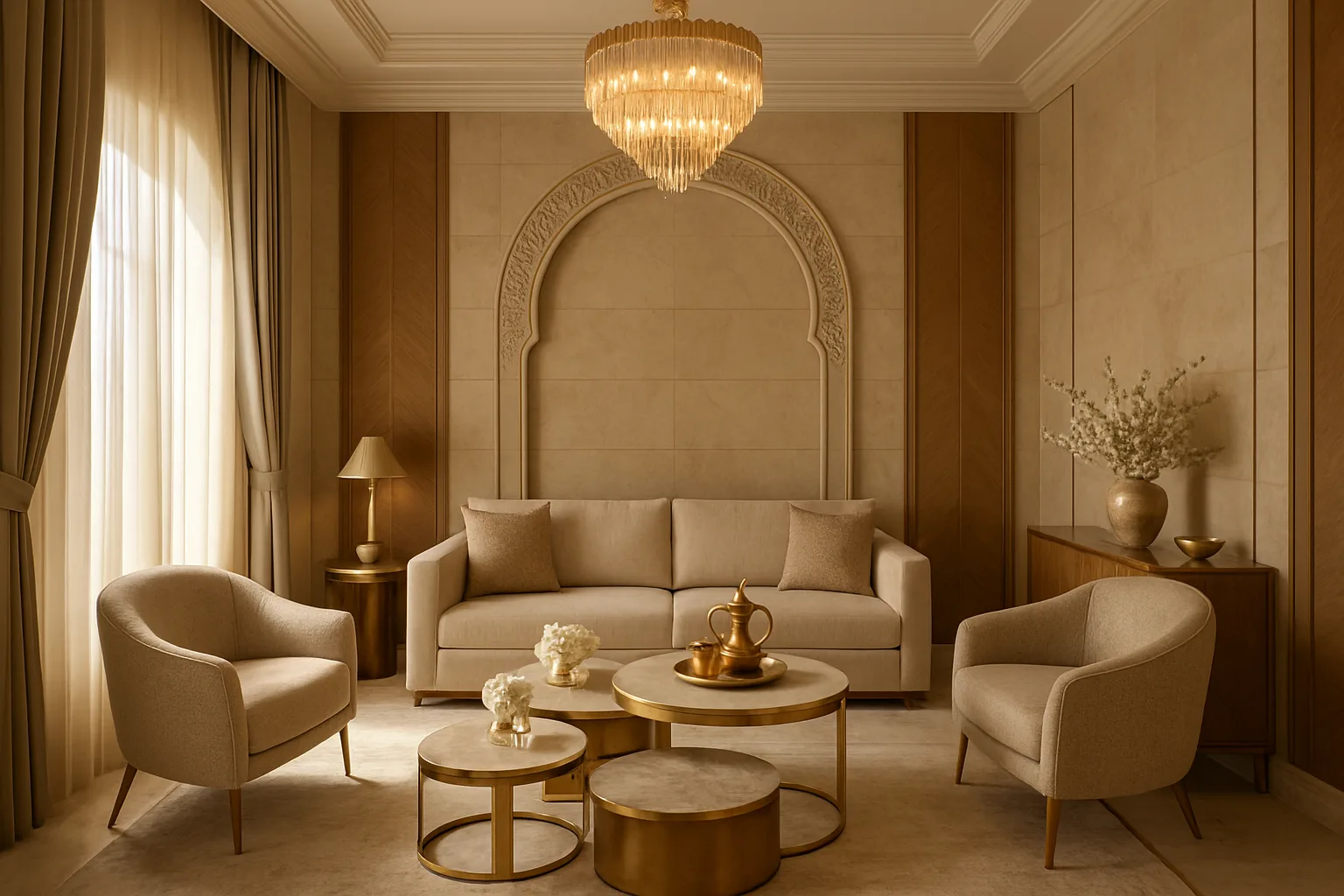
Master the 3-5-7 rule interior design secret to style shelves, consoles, and coffee tables with effortless elegance—perfect for Saudi majlis and living rooms.
What Is the 3-5-7 Rule Interior Design and How Do You Apply It in a Saudi Living Room?
The 3-5-7 rule interior design is a simple yet powerful guideline for arranging accessories in groups of odd numbers—three, five, or seven—to create visual balance, rhythm, and a sense of effortless sophistication. In a Saudi living room or majlis, this rule transforms cluttered surfaces into curated vignettes that honor both modern aesthetics and traditional hospitality. The principle works because odd-numbered groupings force the eye to move naturally across a display, preventing the static, overly symmetrical look that even numbers often produce. For example, a console table behind your majlis sofa can hold three sculptural brass vases of varying heights, while a coffee table might feature five carefully chosen objects—a marble tray, a ceramic bowl, a stack of art books, a small green plant, and a candle—arranged in a loose triangle.
In the context of Saudi interiors, where majlis spaces are designed for gathering and conversation, the 3-5-7 rule helps you avoid the common pitfall of over-accessorizing. Many homeowners in Khobar and Riyadh fill every surface with family photos, decorative plates, and souvenirs, resulting in visual noise that detracts from the room’s architectural features. By limiting yourself to odd-numbered groupings, you create breathing room that allows each piece to shine. This is especially important in majlis settings where low seating and floor cushions draw the eye downward—your accessories should complement, not compete with, the rich textures of your carpets and upholstery. For more guidance on arranging your seating area, check out our majlis sofa arrangement guide.
To start, walk through your living room and identify the key surfaces: the coffee table, side tables, console behind the sofa, and any open shelving. Remove everything and then rebuild each surface using the 3-5-7 rule. On a large coffee table, choose five items that vary in height, texture, and material—for instance, a hammered brass tray from a local souk, a small onyx sculpture, a leather-bound Quran stand (empty or decorative), a glass candle holder, and a small potted succulent. On a narrow console, three items are often enough: a large framed mirror or artwork leaning against the wall, a stack of two or three books, and a single sculptural vase. The key is to vary heights and create a triangular composition that guides the eye naturally.
Remember that the 3-5-7 rule interior design is not a rigid formula but a starting point. In larger majlis rooms with high ceilings and expansive walls, you might scale up to seven items on a long buffet or media console. The rule also applies to wall art—group three or five framed pieces together rather than hanging them in pairs. As you practice, you’ll develop an intuitive sense of balance that feels both curated and lived-in, perfect for the warm, welcoming atmosphere that Saudi homes are known for.
How Do You Style a Majlis Coffee Table Using the 3-5-7 Rule?
The majlis coffee table is the heart of your seating area—it’s where guests place their coffee cups, dates, and conversation. Styling it with the 3-5-7 rule interior design ensures it remains functional yet beautiful. Start with a large, low tray—ideally in hammered brass, dark wood, or marble—that anchors the arrangement. This tray itself counts as one of your five items. Inside the tray, place a small ceramic or glass bowl for dates or sweets, a single candle in a neutral tone, and a small vase with fresh or dried flowers. Outside the tray, add a stack of two or three coffee-table books on Saudi architecture or Islamic art, and a small sculptural object like a carved stone or a piece of modern art glass. This creates a five-item composition that feels intentional and inviting.
In a traditional majlis, where seating is low and guests sit on floor cushions, the coffee table is often lower to the ground. This means your accessories should be viewed from above, so consider items with interesting tops—a bowl with a patterned interior, a tray with engraved details, or a book with a beautiful cover. Avoid tall vases that obstruct sightlines across the table; instead, keep heights low and varied. For a modern Arabic twist, mix materials like travertine, walnut, and brushed brass to echo the warm, earthy tones common in Saudi interiors. To ensure your floor coverings complement the arrangement, refer to our rug placement guide for modern Arabic living rooms.
If your majlis has a larger, rectangular coffee table, you can create two separate groupings—one at each end—using the 3-5-7 rule. For example, at one end, place a tray with three items (a small vase, a candle, and a bowl), and at the other end, a stack of books with a single sculptural object on top. This approach maintains balance without making the table feel crowded. Alternatively, for a round table, a single central grouping of five items works best, arranged in a loose cluster rather than a straight line.
Remember that the coffee table is also a functional surface. Leave at least one-third of the table clear for actual use—guests need space to set down their cups or a plate of dates. The 3-5-7 rule interior design helps you achieve this by encouraging you to edit ruthlessly. If an item doesn’t serve a purpose or bring you joy, remove it. In Saudi culture, hospitality is paramount, so your coffee table should always feel ready to welcome guests without looking staged or museum-like.
What Are the Best Accessories for a Saudi Living Room Using the 3-5-7 Rule?
Choosing the right accessories is just as important as the grouping rule itself. In a Saudi living room, you want pieces that reflect your heritage while embracing contemporary design. Consider incorporating local materials like Saudi marble—such as the beige and cream tones of ‘Riyadh Beige’ or the darker ‘Khobar Grey’—into small objects like coasters, trays, or bookends. Wood species like oak, walnut, and teak add warmth, while brass and copper bring a subtle glow that complements the golden hour light streaming through your windows. For a touch of luxury, include a small piece of onyx or a crystal decanter—these items catch the light and add depth to your vignette. For more ideas on material selection, see our guide on choosing stone and marble for Saudi homes.
When applying the 3-5-7 rule interior design, think about the story you want to tell. A grouping of five items might include a framed family photo, a hand-thrown ceramic vase, a stack of books on Saudi history, a small potted olive tree, and a vintage brass incense burner (mabkhara). This combination speaks to family, culture, and nature—all important elements in Saudi home life. The incense burner is particularly meaningful, as it’s used to perfume the majlis during gatherings, making it both decorative and functional.
For a more modern, minimalist look, choose accessories in a monochromatic palette with varying textures. For example, a grouping of three items on a side table could be a white marble vase, a cream linen-wrapped box, and a small silver-framed mirror. The subtle variations in texture—smooth stone, soft fabric, and reflective metal—create interest without adding color that might clash with your neutral sofa. This approach works well in contemporary Khobar apartments where the aesthetic is clean and understated. If you’re working with a compact space, our modern Arabic design guide for small Khobar apartments offers additional styling tips.
Don’t forget the walls. The 3-5-7 rule applies to wall art as well. Instead of hanging a single large piece, consider a gallery wall with five or seven frames of varying sizes, arranged asymmetrically. Mix traditional Islamic geometric patterns with modern abstract prints, or combine black-and-white photography with a single colorful piece. In a majlis, a grouping of three large mirrors with arched tops can visually expand the space and reflect light, making the room feel larger and more welcoming.
How Does the 3-5-7 Rule Work on Shelves and Consoles in a Saudi Home?
Open shelving and consoles are common in Saudi living rooms, often used to display family treasures, Quranic calligraphy, or decorative objects. The 3-5-7 rule interior design is perfect for these surfaces because it prevents the ‘cluttered shelf’ look while allowing you to showcase multiple items. On a standard bookshelf, divide the space into sections—each section can hold a grouping of three, five, or seven items depending on its width. For a narrow shelf, three items are ideal: a stack of books, a small sculpture, and a framed photo. For a wider shelf, five items allow more variety: a large vase, a bowl, a candle, a bookend, and a small plant.
When styling a console table behind a sofa, the 3-5-7 rule helps you create a focal point without blocking the view. Place a large mirror or artwork as the backdrop, then arrange three to five items in front. For example, a tall vase on one side, a stack of books in the center, and a small sculpture on the other side—this creates a balanced triangle. In a Saudi majlis, the console often holds a coffee set or a tray with dates for guests. You can incorporate these functional items into your grouping: a brass coffee pot (dallah) and two small cups can count as three items, arranged on a tray with a small vase of flowers.
For floating shelves, treat each shelf as its own vignette. On a shelf with three items, vary the heights: a tall candlestick, a medium-sized bowl, and a small framed picture. On a shelf with five items, create a rhythm by alternating heights and textures—tall, short, medium, small, tall. This creates a sense of movement that draws the eye along the shelf. In a modern Arabic interior, you might mix a geometric ceramic vase with a wooden carved box and a small brass lantern, echoing the patterns found in traditional mashrabiya screens.
One common mistake is to fill every inch of a shelf. The 3-5-7 rule interior design encourages negative space—empty areas that allow the eye to rest. In Saudi homes, where hospitality and generosity are valued, it’s tempting to display every gift or souvenir you’ve received. But editing is key. Choose pieces that have meaning or beauty, and let them breathe. You can always rotate items seasonally—for example, swap out a summer-themed vase for a warmer, cozier piece in winter. This keeps your decor fresh without requiring a complete overhaul.
What Are Common Mistakes to Avoid When Using the 3-5-7 Rule in a Majlis?
One of the most common mistakes is treating the 3-5-7 rule interior design as a strict count rather than a guideline. Forcing exactly five items onto a small side table can look just as cluttered as having ten. The rule is about visual weight and balance, not arithmetic. If a surface is small, three items might be plenty; if it’s a large buffet, seven might still feel sparse. Always consider the scale of the furniture and the room. In a spacious Khobar villa majlis, a long console might need seven substantial pieces to anchor the wall, while a compact apartment in Riyadh might only accommodate three delicate objects.
Another mistake is ignoring height variation. If all your items are the same height, the grouping looks flat and monotonous. The 3-5-7 rule works best when you create a triangular composition—tall items at the back or center, shorter items in front. For example, on a coffee table, place a tall vase at one end, a medium bowl in the middle, and a low candle at the other end. This creates a visual line that guides the eye. In a majlis, where seating is low, you might need taller items to draw the eye upward, such as a floor vase or a tall plant placed next to the seating area.
A third mistake is using the rule on every surface simultaneously, which can make the room feel repetitive. If your coffee table has a five-item grouping, your side tables should have three, and your console might have seven—but not all in the same style. Vary the types of items and materials to create interest. For instance, if your coffee table features brass and marble, your side table could feature wood and ceramic. This prevents the ‘matchy-matchy’ look that can feel sterile.
Finally, don’t forget the importance of negative space. The 3-5-7 rule is not about filling every inch—it’s about creating curated moments. In a Saudi majlis, where the room is often filled with plush carpets, low seating, and rich textiles, a little emptiness on your shelves and tables provides visual relief. Leave at least one-third of each surface empty. This not only makes the room feel more spacious but also highlights the items you do display. Remember, the goal is to create a space that feels welcoming and elegant, not a showroom.
How Can You Adapt the 3-5-7 Rule for Different Room Sizes in Saudi Homes?
In a small Khobar apartment, the 3-5-7 rule interior design must be scaled down to avoid overwhelming the space. Use groupings of three on side tables and small consoles, and limit wall art to a single piece or a triptych. Choose accessories that serve dual purposes—a storage ottoman that also acts as a coffee table, or a decorative ladder that holds throws and also adds vertical interest. In small spaces, every item should earn its place. For example, a three-item grouping on a narrow console might include a mirror (to reflect light and make the room feel larger), a small plant (to add life), and a stack of books (to add color and texture).
In a large majlis in a Riyadh villa, you have more freedom to use larger groupings. A long console can hold seven items, such as a large vase, a sculpture, a stack of books, a bowl, a candle, a framed photo, and a small plant. The key is to vary the scale—mix a tall floor vase with a low, wide bowl to create drama. In a grand majlis with high ceilings, consider using oversized accessories that match the room’s proportions. A huge ceramic urn or a large brass tray on a stand can anchor a corner, while a grouping of five large cushions on the floor can echo the 3-5-7 rule in your soft furnishings.
For medium-sized living rooms, which are common in Saudi townhouses, the rule adapts easily. Use five-item groupings on the main coffee table, three on side tables, and seven on a media console or bookshelf. This creates a sense of abundance without clutter. In a typical Saudi living room that combines a seating area with a dining space, apply the rule to each zone separately. The coffee table might have five items, while the dining table centerpiece could be a single large bowl or a grouping of three candles.
Climate also plays a role. In Saudi Arabia’s hot, arid climate, natural materials like wood, stone, and ceramics feel grounding and cool. Avoid plastic or shiny synthetic materials that can look cheap and trap heat. Incorporate plants that thrive indoors, such as the snake plant or the ZZ plant, which require minimal water and tolerate air conditioning. A grouping of three small potted plants on a shelf can bring life to a room without adding maintenance burden. The 3-5-7 rule interior design is flexible enough to work in any room size—you just need to adjust the scale and number of items to suit your space. If you’re planning a larger renovation, our residential design guide for Khobar can help you coordinate all the elements.
How Do Lighting and Color Enhance the 3-5-7 Rule in Saudi Living Rooms?
Lighting is the unsung hero of the 3-5-7 rule interior design. The way light hits your accessories can make or break the composition. In a Saudi living room, where natural light is abundant but harsh in summer, use sheer curtains to diffuse sunlight and create a soft glow that highlights your groupings. In the evening, layer lighting: a central chandelier or pendant for overall illumination, floor lamps for ambient light, and table lamps or spotlights to accent specific vignettes. For example, a small spotlight aimed at a five-item grouping on a console can create dramatic shadows that add depth and interest.
Color also plays a crucial role. The 3-5-7 rule works best when your accessories share a cohesive color palette, even if they vary in texture and material. In a modern Arabic interior, consider a palette of warm neutrals—beige, cream, terracotta, and soft gold—that echoes the desert landscape. Add a single accent color, such as deep teal or emerald green, to create a focal point. For instance, a grouping of five items might include a green ceramic vase, a beige marble tray, a brass candle holder, a cream linen book, and a small wooden sculpture. The green vase draws the eye, while the other items provide a harmonious backdrop.
In a traditional majlis, where rich colors like burgundy, navy, and gold are common, the 3-5-7 rule helps you balance these bold hues. Use metallic accessories—brass, copper, or gold—to reflect light and add a sense of luxury. A grouping of three brass lanterns in different sizes can create a warm, inviting glow that complements the room’s opulent textiles. Alternatively, a five-item grouping with a mix of colored glass, ceramic, and wood can add vibrancy without overwhelming the senses.
Don’t forget the power of negative space in lighting. Shadows are just as important as light. When arranging your accessories, consider how they will cast shadows at different times of day. In the late afternoon, the low sun can create long, dramatic shadows that add a sculptural quality to your groupings. In the evening, warm artificial light can make brass and copper glow, while cool LED light can make marble and glass sparkle. Experiment with different lighting scenarios to see how your 3-5-7 arrangements transform throughout the day.
◈ Key Takeaways
- ✦Use odd-numbered groupings (3, 5, or 7) on every surface to create visual balance and avoid clutter in your Saudi living room or majlis.
- ✦Anchor your coffee table with a large tray, then build a five-item grouping that leaves space for functional use—perfect for majlis hospitality.
- ✦Select accessories that blend local materials (marble, brass, wood) with personal mementos, and apply the 3-5-7 rule to walls and surfaces alike.
- ✦Apply the 3-5-7 rule to each shelf or console section, leaving negative space to let each piece shine—perfect for displaying Saudi heritage items.
- ✦Avoid forcing exact counts, ignoring height variation, overusing the rule, and forgetting negative space—balance is the true goal.
- ✦Scale the 3-5-7 rule to your room size—use smaller groupings in compact spaces and larger ones in grand majlis, always considering climate and materials.
- ✦Use layered lighting and a cohesive color palette to enhance your 3-5-7 groupings—shadows and highlights add depth and drama.
Frequently Asked Questions
❓ What is the 3-5-7 rule in interior design?
The 3-5-7 rule is a styling guideline that suggests grouping decorative items in odd numbers—specifically 3, 5, or 7—to create visually appealing and balanced arrangements. In Saudi living rooms, this rule is often applied to shelves, coffee tables, or console tables, using items like vases, candles, or traditional Arabic coffee pots to achieve a harmonious look.
❓ How do I apply the 3-5-7 rule to my Saudi living room?
To apply the 3-5-7 rule, start by selecting a focal point like a sofa or a wall unit. Group decorative objects in odd numbers—for example, place three items on a coffee table, five on a shelf, or seven on a large console. Mix heights, textures, and colors, and incorporate local elements like a dallah (Arabic coffee pot) or lanterns to add a Saudi touch.
❓ Can I use the 3-5-7 rule with traditional Saudi decor?
Absolutely! The 3-5-7 rule works beautifully with traditional Saudi decor. You can group items like a set of three brass trays, five embroidered cushions, or seven small lanterns to create a focal point. This rule helps blend modern styling with cultural elements, making your living room feel both stylish and authentically Saudi.
❓ How much does it cost to style a living room using the 3-5-7 rule in Saudi Arabia?
The cost varies depending on your choices. For budget-friendly options, you can find decorative items at local souks or stores like IKEA for as little as SAR 50–100 per item. For high-end pieces from brands like Pottery Barn or local boutiques, expect to spend SAR 300–500 per item. A complete styling project using the 3-5-7 rule might range from SAR 500 to SAR 2,000, depending on the number of items and quality.
❓ Why is the 3-5-7 rule important for interior design in Saudi homes?
The 3-5-7 rule is important because it creates visual balance and prevents clutter, which is especially valuable in Saudi living rooms where hospitality is key. Odd numbers are more dynamic and pleasing to the eye, making your space feel inviting for guests. It also allows you to showcase cultural pieces without overwhelming the room, aligning with modern Saudi interior trends.
Ready to Transform Your Space?
Ready to transform your living room or majlis with the 3-5-7 rule? Book a personalized design consultation with SB Interior Design in Khobar—we’ll help you curate every surface with elegance and intention.
SB Interior Design
Quiet Luxury Interior Design — Khobar, Saudi Arabia