

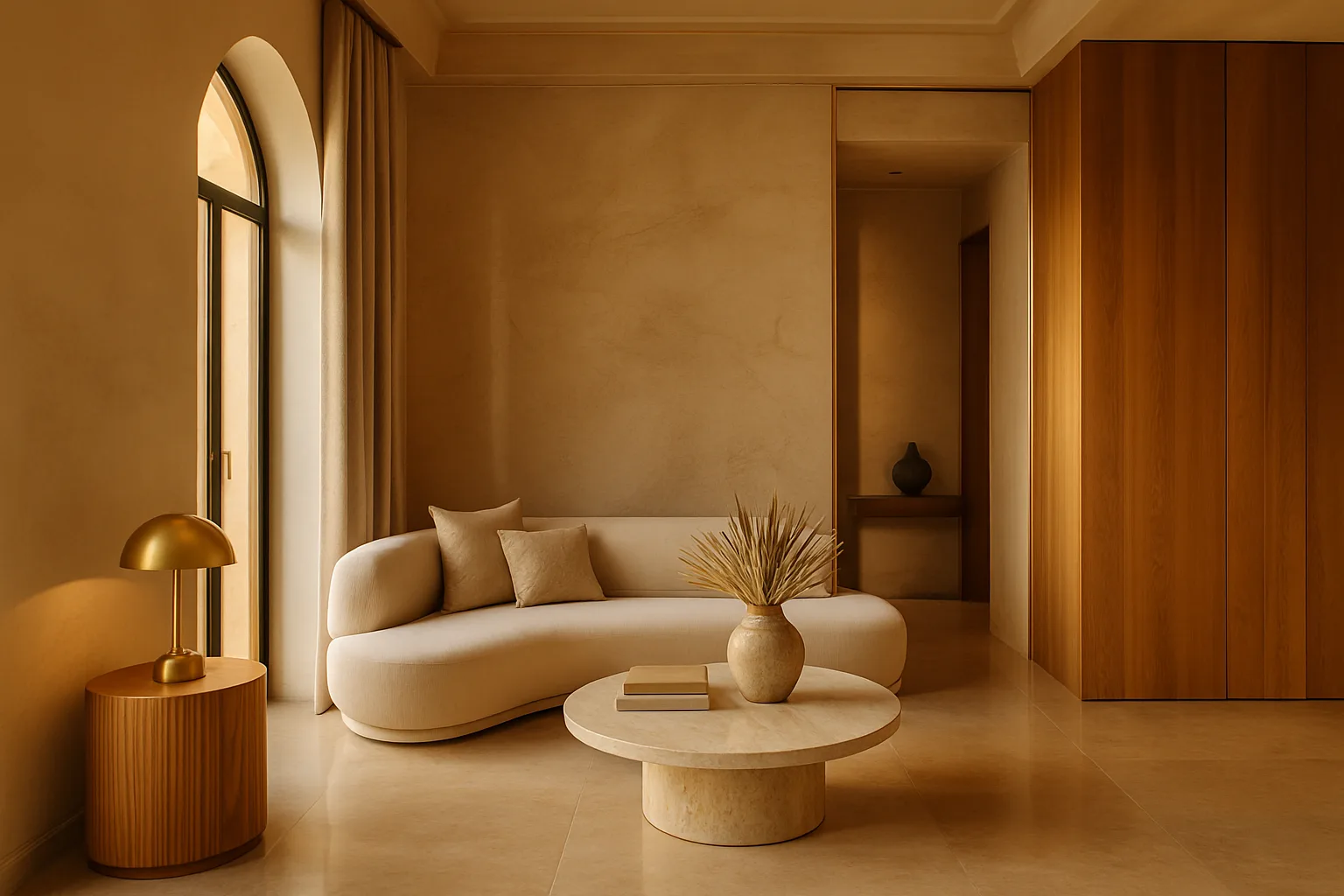
A step-by-step guide to building a mood board that bridges your vision and your designer’s execution—tailored for Saudi homes.
What Is a Mood Board and Why Does Your Saudi Renovation Need One?
A mood board interior design tool is a visual collage of materials, colors, textures, and furniture images that captures the essence of your desired space. For a Saudi home renovation, it acts as a bridge between your inspiration and your designer’s execution—ensuring that the quiet-luxury aesthetic you envision in Khobar or Riyadh is translated accurately into every marble slab, fabric swatch, and lighting fixture. Without a mood board, you risk miscommunication, costly revisions, and a final result that feels disjointed rather than cohesive.
In the Saudi context, where homes often blend traditional Arabic elements with contemporary luxury, a mood board becomes even more critical. It allows you to articulate how you want a majlis to feel—whether it’s the warmth of a desert-toned palette or the crisp elegance of white marble with brass accents—without relying on vague adjectives. Your designer can then source specific materials like Calacatta gold marble or smoked oak wood that match your board’s visual language, saving weeks of back-and-forth.
Moreover, a mood board helps you make confident decisions about the big-ticket items: the stone for your entrance floor, the fabric for your majlis sofas, the finish of your ceiling coves. By seeing these elements together before you commit, you avoid the common pitfall of choosing a stunning material in isolation that clashes with the overall scheme. For homeowners in Saudi Arabia’s humid Eastern Province or the arid capital, a mood board also lets you test how materials will feel against the local climate—for instance, opting for breathable linen over heavy velvet in Khobar’s summers.
Finally, a mood board is a living document. It evolves as you visit showrooms, see new products, or refine your taste. It becomes the single source of truth for every decision, from the joinery details in your bespoke kitchen to the profile of your ceiling lighting. In a market as dynamic as Saudi Arabia’s, where design trends shift rapidly, a mood board keeps you anchored to your personal style rather than fleeting fads.
How Do You Start a Mood Board for a Saudi Home?
Starting a mood board interior design project begins with gathering inspiration from multiple sources—Pinterest, Instagram, design magazines, and even your own travel photos. For a Saudi home, look for images that resonate with your cultural identity: the geometric patterns of Arabic mashrabiya screens, the warm glow of lantern-lit courtyards, or the serene minimalism of modern Islamic art. Save everything that catches your eye, even if you don’t know why yet. This raw collection is your starting point.
Next, organize your inspiration by room or by design principle. For instance, create separate boards for your majlis, your master bedroom, and your villa entrance. Within each board, group images by color palette, material texture, and furniture style. As you do this, patterns will emerge—you’ll notice you’re drawn to cool greys with warm wood accents, or to the contrast of black steel against cream limestone. These patterns become the foundation of your design brief.
Once you have a substantial collection, edit ruthlessly. Remove images that feel off-brand or that you no longer love. Aim for 10-15 images per room that clearly express the mood you want. Then, distill these into a single board—either physical or digital—that you can share with your designer. Tools like Canva or Milanote are excellent for digital boards, but a physical corkboard with fabric swatches and material samples can be even more powerful, especially when you want to feel the textures.
Finally, annotate your board with notes. Write down why you chose each element: ‘This marble reminds me of the desert dunes at dawn,’ or ‘This brass finish echoes the traditional Arabic coffee pots.’ These annotations give your designer insight into your emotional and cultural connections, allowing them to make informed suggestions that align with your vision. In Saudi Arabia, where family gatherings and hospitality are central, these notes often reveal a desire for spaces that are both grand and intimate—a balance your designer can then achieve.
What Materials and Colors Should You Include in Your Mood Board?
When selecting materials for your mood board interior design, focus on those that define the character of your Saudi home. Marble is a perennial favorite—consider varieties like Bianco Dolomiti for a light, airy feel, or Nero Marquina for dramatic contrast. In Khobar’s humid climate, porcelain tiles that mimic marble offer durability without sacrificing elegance. For wood, smoked oak and walnut bring warmth, while teak is ideal for outdoor spaces that withstand the Eastern Province’s heat. Each material should be represented by a physical sample or a high-resolution image on your board. For more detailed guidance on selecting the right surfaces, refer to our guide to choosing stone and marble for Saudi homes.
Color palettes for Saudi homes often draw from the natural landscape: warm sand, terracotta, deep olive, and the blues of the Arabian Gulf. For a quiet-luxury aesthetic, you might choose a neutral base of ivory and greige, accented with muted gold or bronze. These tones create a serene backdrop that allows architectural details—like a carved gypsum ceiling or a feature wall in textured limewash—to shine. Your mood board should show these colors in large swatches, so you can see how they interact under different lighting conditions.
Don’t forget the tactile elements. Include fabric samples for your upholstery and drapery: a bouclé for the majlis sofas, a silk-blend for the curtains in your formal living room, and a performance velvet for high-traffic areas. In Saudi homes, where floor seating is common in majlis settings, the texture of your cushions and rugs is paramount. Add a piece of a wool-and-silk rug that echoes the geometric patterns of the region, and a sample of the leather you plan to use for your study’s armchair. For more on this, see our rug placement guide for modern Arabic living rooms.
Finally, consider the lighting fixtures as part of your material palette. A hand-blown glass pendant from Murano, a brass chandelier with Arabic calligraphy cutouts, or a minimalist track system for your art wall—each contributes to the mood. Your mood board should include images of these fixtures, along with notes on the type of light they emit: warm and diffused for the majlis, bright and focused for the kitchen workspace. This level of detail ensures that your designer can specify the right products, avoiding the disappointment of a fixture that looks beautiful but fails to create the desired ambiance.
How Do You Incorporate Arabic Design Elements Without Clichés?
Incorporating Arabic design elements into your mood board interior design requires a delicate balance between heritage and modernity. The goal is to evoke the spirit of the region—its geometry, its light, its sense of hospitality—without resorting to literal reproductions of traditional motifs. Start by studying the patterns of Islamic art: the eight-pointed star, the arabesque vine, the muqarnas vaulting. Choose one or two that resonate with you and reinterpret them in a contemporary way, such as a laser-cut metal screen for your staircase or a subtle inlay in your marble floor.
Another approach is to focus on the materials and techniques that define Arabic craftsmanship. Consider a jali screen in carved wood or stone that filters the harsh Saudi sunlight into dappled patterns on your interior walls. Or a plaster wall finish with a hand-troweled texture that mimics the aged surfaces of historic buildings in Jeddah or AlUla. These elements add depth and authenticity without overwhelming the space. Your mood board should include close-up photos of such details, along with notes on how they might be adapted to your home. For inspiration on blending these elements, explore our guide to natural elements in modern Arabic interiors.
Lighting is another powerful vehicle for Arabic design. The play of light and shadow is central to Islamic architecture, and you can capture this with modern fixtures that cast intricate patterns—a pendant lamp with a perforated brass shade, or a wall sconce that projects a geometric silhouette. On your mood board, include images of these lighting effects, as well as the fixtures themselves. This helps your designer understand the importance of ambient lighting in creating a serene, contemplative atmosphere.
Finally, think about how you can incorporate Arabic elements through furniture and accessories. A majlis seating arrangement with low, plush sofas and floor cushions is inherently Arabic, but you can update it with contemporary fabrics and clean lines. A traditional Arabic coffee set, displayed on a modern sideboard, becomes a sculptural focal point. Your mood board should show these pieces in context, demonstrating how they coexist with your modern furniture. The key is to curate, not to decorate—each element should have a purpose and a place, contributing to the overall narrative of your home.
How Do You Use a Mood Board to Communicate with Your Interior Designer?
A mood board is your most powerful communication tool when working with an interior designer in Saudi Arabia. It transcends language barriers and subjective descriptions, providing a visual reference that both you and your designer can interpret objectively. When you present your mood board, start by explaining the overall feeling you want to achieve—whether it’s ‘a serene retreat from the desert heat’ or ‘an elegant space for entertaining guests.’ Then, walk through each element, explaining its significance and how you envision it in your home.
Your designer will use your mood board to guide every decision, from the architectural layout to the smallest decorative accent. They might suggest alternatives that better suit your space or budget, but they will always refer back to your board to ensure the essence remains intact. For example, if your board features a specific marble, your designer might propose a comparable stone that is more readily available in Riyadh or more suitable for Khobar’s humidity. This collaborative process ensures that you get the look you want without compromising on practicality.
To make the most of your mood board, be open to feedback. Your designer brings expertise in spatial planning, material durability, and lighting design—elements that you might not have considered. They might point out that the dark wood you love will make a small room feel smaller, or that the delicate silk fabric you chose won’t withstand the wear of a family majlis. Trust their professional judgment, but also advocate for your vision. A good designer will find a way to honor both. If you’re still searching for the right professional, our guide to choosing an interior designer in Saudi Arabia can help you make an informed decision.
Finally, use your mood board as a benchmark throughout the renovation. When you visit the site and see the progress, refer back to your board to check that the colors, materials, and overall vibe are aligning. If something feels off, discuss it with your designer immediately, using the board as a reference point. This proactive approach prevents small deviations from becoming major disappointments. In the fast-paced Saudi design scene, where projects often move quickly, a mood board keeps everyone on the same page, ensuring a smooth and satisfying renovation experience.
What Are the Common Mistakes to Avoid When Creating a Mood Board?
One of the most common mistakes in mood board interior design is being too vague. If your board consists solely of beautiful but generic images—a minimalist living room, a marble kitchen—it doesn’t provide enough direction. Your designer needs specifics: the exact shade of white, the type of wood grain, the scale of the furniture. Include close-ups of materials, fabric swatches, and paint color chips. The more detailed your board, the more accurate the execution.
Another pitfall is mixing too many styles without a unifying theme. You might love the warmth of rustic farmhouse, the elegance of Art Deco, and the simplicity of Japanese minimalism, but combining all three in one board creates confusion. Instead, choose one primary style and use elements from others as accents. For a Saudi home, you might start with a contemporary Arabic aesthetic and add touches of Moroccan or Andalusian influence. Your mood board should tell a coherent story, not a chaotic one.
Ignoring the practicalities of your space is another common error. A mood board filled with images of vast, double-height living rooms is unrealistic if your apartment in Khobar has standard 3-meter ceilings. Be mindful of your actual space and choose images that reflect its proportions. Similarly, consider your budget. If your board features exotic materials like onyx or hand-carved wood, be prepared for the cost. Your designer can help you prioritize where to splurge and where to save, but your board should be grounded in reality.
Finally, don’t forget to include the ‘feel’ of the space. A mood board that only shows visual elements misses the sensory experience—the sound of a water feature, the scent of oud, the softness of a wool rug underfoot. Add notes or images that evoke these sensations. For example, a photo of a serene courtyard with a fountain can communicate the desire for a tranquil outdoor space. By addressing all the senses, your mood board becomes a holistic guide that ensures your renovated home is not just beautiful, but also a true sanctuary.
How Do You Translate Your Mood Board into a Final Design Plan?
Translating your mood board interior design into a final design plan is the exciting culmination of your creative process. This is where your designer takes the visual language you’ve developed and turns it into detailed drawings, specifications, and schedules. The first step is a thorough review of your mood board, where your designer identifies the key elements that will define the design: the color palette, the material selections, the furniture styles, and the lighting concepts. They will then create a concept statement that summarizes the design direction, which you can approve or refine.
Next, your designer will develop a space plan that arranges your furniture and architectural features according to the mood board’s aesthetic. For a Saudi home, this might involve designing a majlis that flows seamlessly into a dining area, or creating a private majlis for family gatherings separate from a more formal reception room. The space plan ensures that the layout supports your lifestyle and the mood you want to achieve. Your designer will also specify the built-in elements—like joinery, ceiling details, and lighting layouts—that are crucial to the design.
Once the space plan is approved, your designer will produce detailed drawings and 3D renderings that bring your mood board to life. These visuals allow you to see how the materials, colors, and lighting will look in your actual space, before any construction begins. This is the time to make adjustments—perhaps the marble you chose looks too busy on a large floor area, or the pendant light you loved is too large for the space. The renderings are your opportunity to fine-tune the design, ensuring that the final result matches your vision. To get the most out of this phase, learn how to read 3D renderings before you renovate.
Finally, your designer will prepare a specification schedule that lists every item needed for the project, from the stone slabs to the door handles. This schedule is your shopping list and your quality control checklist. It ensures that the materials used on site match the samples on your mood board, and that nothing is left to chance. With a comprehensive plan in hand, you can proceed with confidence, knowing that your renovation will be executed with precision and artistry. In the vibrant design landscape of Saudi Arabia, where luxury and tradition meet, a well-executed mood board is the key to a home that is both personal and timeless.
◈ Key Takeaways
- ✦Start your mood board by gathering diverse inspiration, then edit ruthlessly to distill a clear, cohesive vision.
- ✦Include physical samples of materials—marble, wood, fabric—to ensure accurate color and texture matching.
- ✦Incorporate Arabic design elements thoughtfully, using patterns and materials that evoke heritage without clichés.
- ✦Use your mood board as a communication tool with your designer, explaining the ‘why’ behind each choice.
- ✦Translate your mood board into a detailed design plan with space layouts, 3D renderings, and a specification schedule.
Frequently Asked Questions
❓ How to create a mood board for interior design?
Start by gathering inspiration from Pinterest, magazines, or local showrooms in Khobar. Select a color palette, textures, and furniture styles that reflect your vision, then arrange them on a physical board or digital tool like Canva. For a Saudi home, incorporate elements like Arabic patterns or traditional materials to add local character.
❓ What is a mood board in interior design?
A mood board is a visual collage of images, materials, and colors that captures the overall feel and direction of a design project. It helps you communicate your ideas clearly to designers or contractors, ensuring everyone is aligned before any work begins. In Saudi Arabia, it’s a common first step in luxury interior design projects.
❓ What should be included in an interior design mood board?
Include a color palette, fabric swatches, furniture images, lighting ideas, and any architectural details you love. Also add texture samples like wood, stone, or metal to convey the tactile feel. For a Saudi home, consider adding traditional elements like mashrabiya screens or geometric patterns to blend heritage with modernity.
❓ How much does it cost to hire an interior designer in Saudi Arabia?
Interior design fees in Saudi Arabia typically range from SAR 200 to SAR 500 per hour, or a flat fee of SAR 5,000 to SAR 20,000 for a full room design. Creating a mood board yourself can save money, but a professional can ensure a cohesive and functional result. Many designers in Khobar offer initial consultations to discuss your budget and vision.
❓ Why is a mood board important for a home renovation in Saudi Arabia?
A mood board is crucial because it helps you visualize the final outcome before investing in expensive materials or furniture. It also facilitates better communication with contractors and suppliers, reducing the risk of costly mistakes. In Saudi Arabia, where many homes feature intricate designs, a mood board ensures that every element harmonizes with the local aesthetic and climate.
Ready to Transform Your Space?
Ready to bring your mood board to life? Book a consultation with SB Interior Design today and let our experts craft a home that reflects your unique style.
SB Interior Design
Quiet Luxury Interior Design — Khobar, Saudi Arabia