

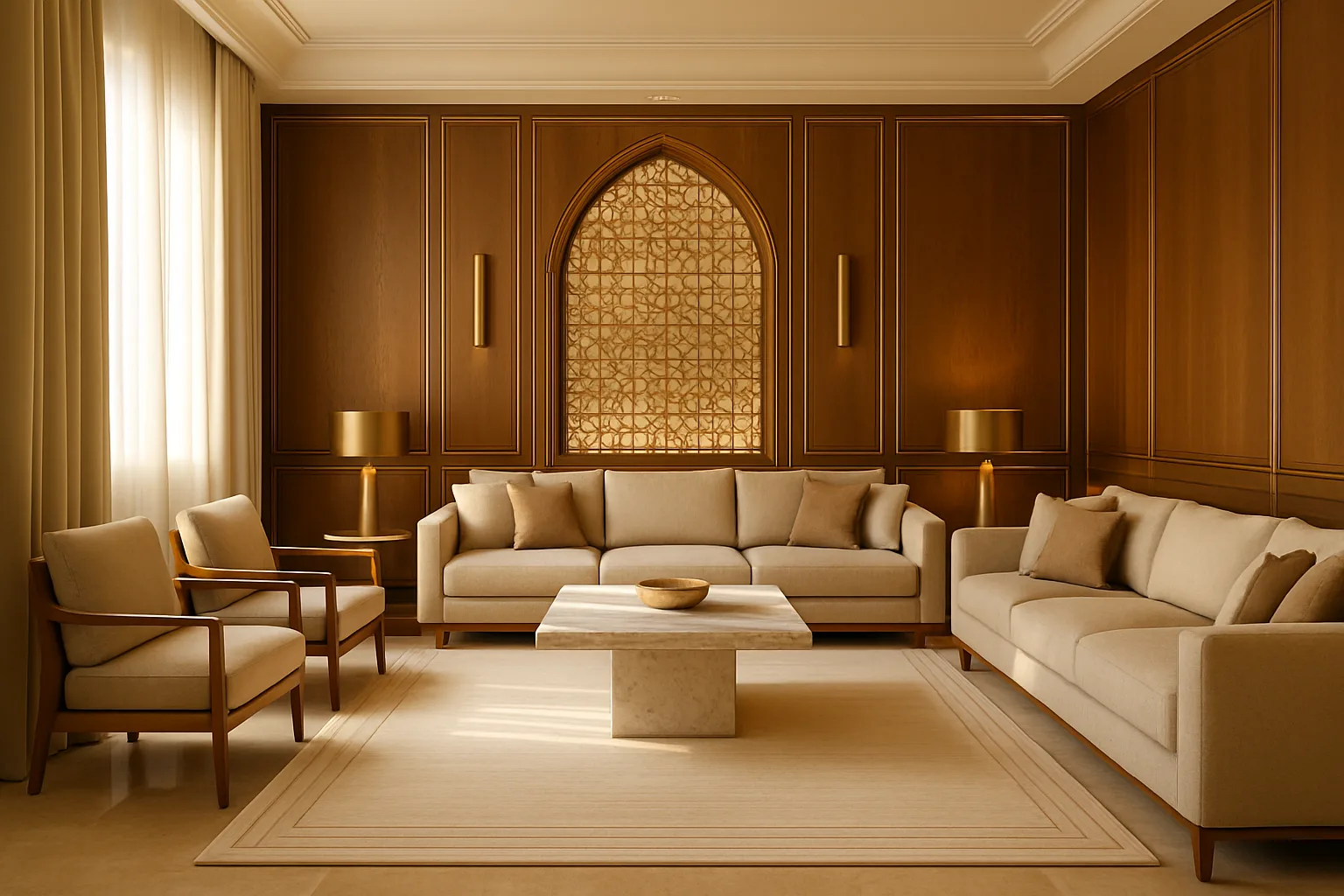
Master rug size, material, and placement for modern Arabic living rooms—from majlis seating to quiet luxury. Practical tips for Saudi homes.
How Do You Choose the Perfect Rug for a Modern Arabic Living Room?
Choosing the right rug starts with defining the room’s function and seating style. In a modern Arabic living room, it’s common to combine a traditional low-seated majlis with a Western-style seating corner. The golden rule: the rug should be large enough to unify the seating area, so that at minimum the front legs of your sofas rest on it. If your majlis is low-seated, choose a rug that extends fully beneath all the seats to create a sense of warmth and cohesion.
The ideal size depends on the room’s dimensions. For a 4×5 meter living room, a 2.5×3.5 meter rug works beautifully. For larger majlis seating that accommodates ten guests or more, a 3×4 meter rug (or larger) will clearly define the space. Remember to leave 30-45 cm between the rug’s edge and the walls to showcase marble or wood flooring, especially if you’re using white Carrara marble or luxurious Bianco Lavina marble. For more ideas on coordinating flooring with the rest of your decor, see Choosing Stone and Marble for Saudi Homes.
In modern home decor, a rug isn’t just a functional piece — it’s an architectural element that guides the eye and defines seating zones. If your living room opens onto the kitchen or entryway, use a statement rug to visually separate the living area without physical barriers. This approach is popular in modern villas across Khobar and Riyadh, where open floor plans meet Arabic notions of privacy.
Don’t forget to measure your space carefully before buying. Use a tape measure and mark furniture placement on the floor with painter’s tape to visualize the actual footprint. A slightly larger rug is always better than one that’s too small — it creates a sense of luxury and spaciousness, while an undersized rug makes a room feel fragmented and uncomfortable.
What Are the Best Rug Materials for Saudi Arabia’s Hot Climate?
The Kingdom’s climate, particularly in Khobar and Dammam, is marked by high summer humidity and persistent dust. That’s why it’s essential to choose practical materials that can withstand these harsh conditions while maintaining a luxurious look. Natural wool is the top choice for comfort and elegance, though it can be heavy and requires special care. An excellent alternative is a wool and art-silk blend, which combines wool’s durability with silk’s sheen at a more accessible price point.
Rugs made from high-quality polypropylene or nylon are ideal for families with children or pets. These materials resist stains, are easy to clean, and now come in designs that convincingly mimic natural wool. In modern home decor, we recommend using polypropylene rugs in high-traffic areas like the main living room, while reserving luxurious silk rugs for formal reception majlis rooms.
For traditional Arabic majlis seating, handmade rugs from Iran, Turkey, or Afghanistan are a genuine investment. These pieces are more than flooring — they’re works of art that tell stories rooted in heritage. If you prefer a more contemporary look, low-pile rugs with geometric or abstract patterns offer an elegant, vacuum-friendly alternative. For a fully coordinated majlis, check out our Guide to Buying Majlis Sofas: Comfort and Elegance.
Also pay attention to rug density (knots per square meter). Higher-density rugs are more durable and hold their shape longer, though they come at a higher price. For everyday use, look for a knot density of at least 200,000 knots per square meter for handmade rugs, or a weight of at least 1.5 kg per square meter for machine-made rugs.
How Do You Coordinate Rug Colors and Patterns with Your Home Decor?
Color is the soul of home decor, and the rug is the canvas that brings every element together. In modern Arabic living rooms, we tend to use neutral tones as a base: beige, gray, off-white, and earth tones. These colors let you swap out cushions and accessories without needing to replace the rug. If your walls are white or ivory, a deeper-toned rug — navy or olive, for example — adds instant depth.
For a contemporary Arabic style, choose geometric patterns inspired by Moroccan zellige tilework or Islamic star motifs, rendered at a larger scale with a modern execution. These patterns pair beautifully with simple, clean-lined furniture. Avoid small, busy repeating patterns, as they can make a room feel cluttered, especially in large spaces. Instead, opt for a single large central motif or scattered accents along the border.
The contrast rule: if your furniture is light-colored, choose a darker rug or one with a bold pattern. If your furniture is dark — brown or charcoal leather sofas, for instance — a lighter rug creates visual balance. In guest majlis rooms that use bold colors like burgundy or emerald green, a neutral rug lets those colors shine without competing for attention.
Don’t overlook lighting when choosing color. In a living room with strong natural light, you can afford deeper tones. In rooms that rely mostly on artificial lighting, a lighter rug reflects light and makes the space feel larger. Bring a rug sample home and view it under your actual lighting before purchasing — colors shift dramatically between daylight and warm artificial light.
What Are the Best Ways to Arrange Rugs in an Arabic Living Room?
Correct rug placement starts with identifying the room’s focal point. In an Arabic majlis, the focal point is often the main seating area or the entrance. Position the rug so it’s oriented perpendicular to the qibla direction or the entryway, while leaving enough clearance to move around it. If you have a fireplace or a TV unit, the rug should extend at least 30-50 cm in front of it.
In an open-plan living room that combines a majlis with a Western-style sofa area, use two separate rugs to clearly define each zone: a larger rug for the majlis and a smaller one for the sofa area. This approach creates visual flow and prevents overcrowding. Make sure the two rugs are complementary in color or pattern — but not identical — to add visual depth.
For tighter spaces, like smaller apartments in Khobar, try placing the rug at a diagonal angle for added dynamism. This unconventional approach draws the eye and makes the room feel larger. But be careful: a diagonally placed rug requires furniture arranged to match, or the room will look chaotic. In that case, choose a round or oval rug to soften sharp angles.
Finally, consider traffic flow. The rug shouldn’t obstruct main pathways between doors and windows. If you have a glass balcony door, leave at least 60 cm of clearance in front of it for easy movement. In larger villas in Riyadh, we recommend layering rugs in groups: a large rug for the main majlis, and smaller rugs for hallways or reading corners, to create a comfortable visual rhythm.
How Do You Choose the Right Rug Size for Your Arabic Majlis?
Rug size is the most common mistake in home decor. The general rule: the rug should be larger than the seating area itself. For a majlis that seats eight, a 3×4 meter rug is the minimum. For a majlis seating ten or more, a 4×5 meter rug provides the visual comfort needed. Remember, an undersized rug makes furniture look like it’s floating without a foundation.
For accurate measuring, add up the dimensions of your main furniture pieces (sofas, chairs, tables) and add 60-90 cm on each side. This ensures all front furniture legs rest on the rug. If you have a central coffee table, make sure the rug extends 45-60 cm beyond the table on each side — this allows chairs to be pulled back without going off the rug.
For majlis seating built into wall alcoves (common in Arabic design), the rug can be slightly smaller since the furniture is fixed in place. In this case, a 2.5×3.5 meter rug is sufficient for a 5×6 meter room. But if you have movable furniture like individual chairs, a larger rug is essential to unify the grouping.
Don’t forget to factor in the room’s shape. For rectangular rooms, choose a rectangular rug in the same orientation. For square rooms, a round rug can break up the monotony. In long, narrow living rooms, place the rug across the width of the room to visually widen it, rather than along its length, which would make it look narrower.
How Do You Integrate Rugs with Other Decor Elements in Your Living Room?
A rug doesn’t exist in isolation from the rest of your home decor. It should harmonize with curtains, sofa cushions, lighting, and even wall art. If your curtains are natural light-beige linen, a rug in the same color family but a shade darker creates an elegant gradient. If your curtains are dark, a lighter rug prevents the room from feeling gloomy.
Lighting plays a critical role in showcasing a rug’s beauty. Use recessed LED lighting along the walls to direct light toward the rug and highlight its texture. In luxurious Arabic majlis rooms, we recommend adding a crystal or brass chandelier at the center, so the rug becomes the element that reflects and distributes light throughout the room. Avoid harsh direct lighting, which fades rug colors over time. For more ideas on integrating lighting with your design, see Modern Arabic Ceiling Design with Integrated Lighting.
For cushions and sofas, choose fabrics that contrast with the rug’s texture. If the rug is smooth and silky, use velvet or chenille cushions for tactile contrast. If the rug is coarse-textured wool, cotton or linen cushions create a comfortable balance. In modern home decor, we follow the 60-30-10 rule: 60% of the room in a neutral color, 30% in a secondary color, and 10% in bold accents like colorful cushions or decorative objects.
Don’t forget artwork and mirrors. If you have a large piece of wall art, choose a rug that echoes one of its colors to create visual cohesion. Large mirrors reflect the rug and double its visual impact, especially when positioned opposite a natural light source. In modern villas in Khobar, we use this trick to add depth to living rooms overlooking the sea.
How Do You Maintain Your Rug So It Lasts in the Saudi Climate?
Regular maintenance is the secret to preserving a rug’s beauty. In Khobar’s humid climate, rugs should be vacuumed at least twice a week to remove dust and fine sand that accumulates in the fibers. Use a rotating brush attachment for low-pile rugs, and a suction-only attachment for delicate silk rugs. Avoid using excessive water, as trapped moisture can lead to mold.
For stains, treat them immediately with a mild cleanser and lukewarm water. Blot the stain from the outside in to prevent it from spreading. Avoid scrubbing vigorously, as this damages the fibers and strips the color. Always test strong chemical cleaners on a hidden section of the rug first. For stubborn stains like tea or coffee, consult a local professional rug cleaner.
Rotating your rug every 6-12 months helps distribute wear evenly, especially in high-traffic areas. If the rug is exposed to direct sunlight, use sheer curtains to filter UV rays that fade colors. During the hot summer months, keep windows closed during peak heat hours to protect the rug from excess heat exposure.
Finally, invest in a high-quality rug pad. A good pad prevents slipping, adds cushioning, and extends the rug’s lifespan by protecting it from direct friction against the floor. In luxury home decor, a quality rug pad makes a real difference underfoot — especially when walking barefoot on a fine wool rug. And if you’re planning a full home renovation, you can rely on our Interior Design and 3D Visualization services to see the final result before construction begins.
◈ Key Takeaways
✦ Choose a rug larger than your seating area, so that at minimum the front legs of your furniture rest on it.
✦ In the Saudi climate, use practical materials like polypropylene for high-traffic areas and natural wool for formal majlis rooms.
✦ Coordinate rug colors with your walls and furniture using the 60-30-10 rule: neutral, secondary, and bold accents.
✦ Layer rugs in open-plan rooms to clearly define seating zones without architectural barriers.
✦ Invest in a quality rug pad and rotate your rug every 6-12 months to extend its lifespan.
✦ Test rug color under your home’s actual lighting before purchasing, since colors shift between day and night.
Let me know when you’re ready with the next part (or if this covers everything you needed — looks like the FAQ, CTA, and meta tags were already covered in my earlier message).
Frequently Asked Questions
❓ How much does it cost to hire an interior designer in Saudi Arabia?
In Saudi Arabia, interior design fees typically range from SAR 200 to SAR 500 per hour, or a flat fee of SAR 5,000 to SAR 20,000 for a full room design. For a complete home design, costs can start from SAR 30,000, depending on the scope and materials. It’s best to request a detailed quote from a local designer like SB Interior Design to match your budget.
❓ What is the best way to arrange a rug in a modern Arabic living room?
In a modern Arabic living room, place the rug so that the front legs of your sofas and chairs sit on it, creating a cohesive seating area. For a more traditional look, center the rug under a majlis-style seating arrangement, leaving a border of 12-18 inches of floor around it. This balances the space and defines the gathering area.
❓ Can I use a large rug in a small living room?
Yes, using a large rug in a small living room can actually make the space feel bigger by visually expanding the floor area. Choose a rug that fits under all key furniture pieces, leaving at least 6-8 inches of bare floor around the edges. This creates a unified look and avoids a cramped feeling.
❓ Which rug material is best for a hot climate like Saudi Arabia?
For Saudi Arabia’s hot climate, natural fibers like wool, cotton, or jute are ideal because they are breathable and help regulate temperature. Wool rugs are durable and resist dust, while cotton is easy to clean. Avoid synthetic materials that can trap heat and static.
❓ Why is rug placement important in Arabic interior design?
Rug placement is crucial in Arabic interior design because it anchors the seating area, adds warmth, and defines the flow of the room. In a majlis or living room, a well-placed rug enhances the aesthetic and comfort, making the space more inviting for guests. Proper placement also protects flooring and reduces noise.
Ready to Transform Your Space?
Need help choosing the perfect rug for your home? Book a free design consultation with the experts at SB Interior Design in Khobar or Riyadh, and let us turn your living room into a work of art.
SB Interior Design
Quiet Luxury Interior Design — Khobar, Saudi Arabia