

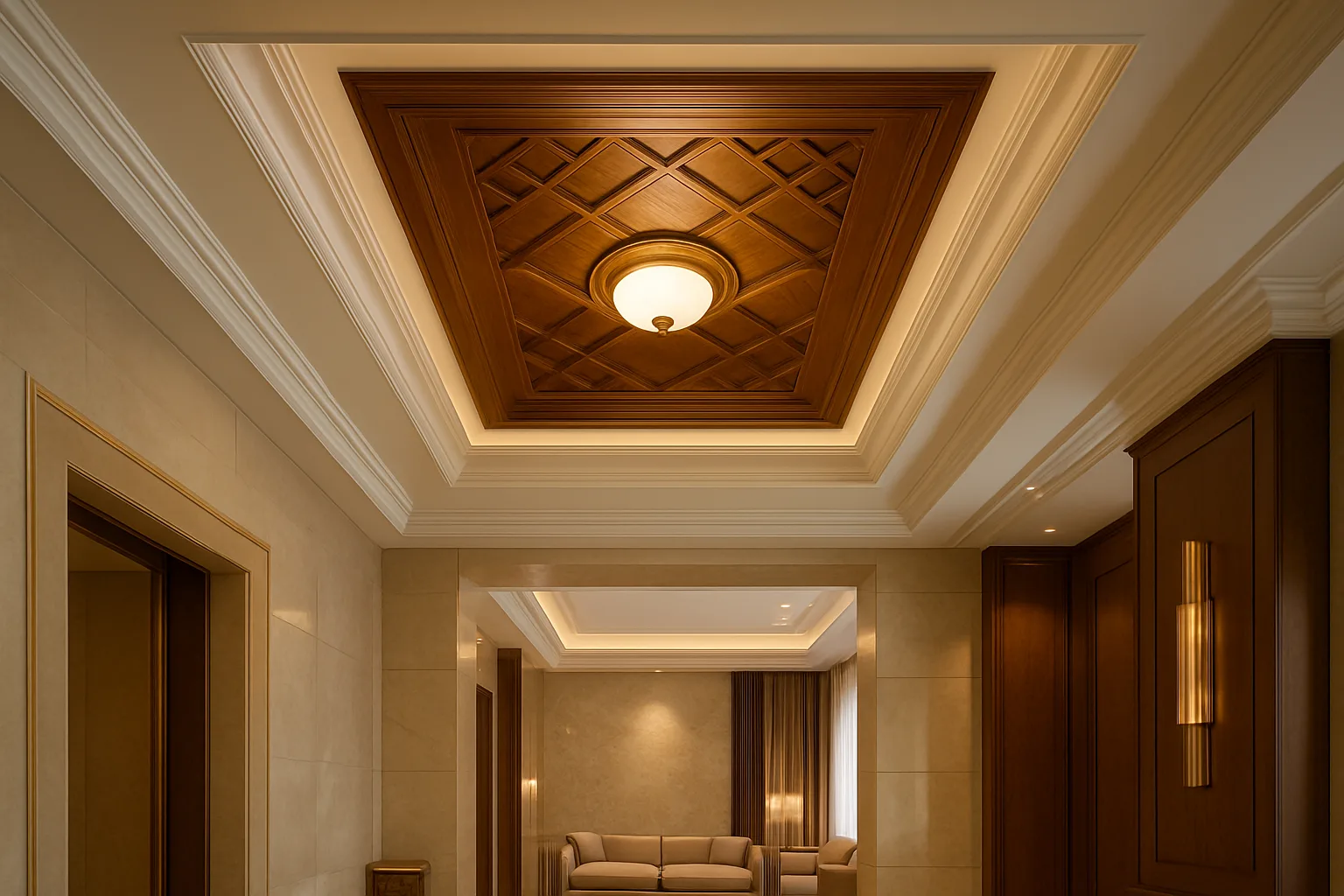
From gypsum to wood, lighting to acoustics—choose the perfect ceiling design for your Saudi home with this expert guide.
What Is the Best Ceiling Design for Your Home in Saudi Arabia?
The best ceiling design for your home in Saudi Arabia combines functional beauty with suitability for the local climate. In our region, where temperatures range from extremely hot summers to mild winters, a ceiling should be as practical as it is beautiful. We recommend that our clients in Khobar and Riyadh consider luxury gypsum ceiling designs for Saudi homes with multiple levels, allowing air-conditioning systems and concealed lighting to be integrated seamlessly. Warm wood accents or acoustic panels can also be added where sound control is needed.
When choosing a ceiling design, always start by measuring the room height. Modern Saudi villas often have ceilings of 3 meters or higher, giving you plenty of flexibility for layered ceiling designs or even vaulted ceilings in majlis spaces. For apartments with lower ceilings below 2.7 meters, we recommend a simple design with clean lines and concealed lighting around the edges to avoid making the room feel cramped.
Remember that ceiling design is not simply a decorative element; it is part of the home’s overall identity. In Saudi Arabia, where the majlis and hospitality are highly valued, the ceiling can become the feature that captures guests’ attention as soon as they enter. Think of your ceiling as a long-term investment: choose designs that will remain elegant for decades rather than following short-lived trends.
What Are the Best Materials for Home Ceilings in Saudi Arabia?
Gypsum is one of the most common choices for Saudi home ceiling design because of its flexibility, ease of installation, and reasonable cost. It can be shaped into classic cornices, contemporary geometric lines, or even botanical forms inspired by Islamic art. In our Khobar projects, we often use high-quality French gypsum because of its smooth finish and resistance to cracking, particularly in coastal areas where humidity is higher.
Wood is another luxurious material that adds warmth and sophistication to any space. In Saudi Arabia, we recommend oak or walnut for full wood ceilings or decorative beams. Natural wood works particularly well in majlis spaces and libraries, but it should be treated against moisture and insects, especially in coastal areas such as Khobar and Dammam. An excellent alternative is engineered MDF with a natural wood veneer, which is more stable and generally more affordable.
For practical applications, moisture-resistant gypsum boards can be used in bathrooms and kitchens, while acoustic panels made from acrylic or compressed polyester can be used in living rooms and home theaters. These panels help absorb sound while offering contemporary shapes and patterns that add visual texture. Ultimately, choose materials according to the room’s function and your budget, and do not be afraid to combine materials such as gypsum with wood or gypsum with brass for a luxurious finish.
How Do You Integrate Lighting Into Ceiling Design?
Lighting is the soul of ceiling design and can transform an ordinary design into something exceptional. In Saudi homes, where warm lighting between 2700K and 3000K is often preferred for a comfortable atmosphere, we recommend using three layers of lighting: ambient lighting such as spotlights or chandeliers, concealed lighting such as LED strips inside coves, and task lighting directed toward elements such as artwork or tables. This layered approach gives you complete control over the atmosphere of the room. You can also explore modern Arabic ceiling design with integrated lighting for more inspiration.
Concealed cove lighting is one of the most popular choices for majlis ceilings and main rooms. An LED strip can be installed behind a raised gypsum edge to create a soft glow that emphasizes ceiling height. In multi-level ceilings, concealed lighting can be added to each level to create visual depth. We recommend high-quality LED strips with at least an IP44 rating in areas exposed to humidity and maintaining a consistent color temperature throughout the room.
Chandeliers are an essential luxury element in main majlis spaces. In modern Arabic interiors, we often select crystal or metal chandeliers with geometric designs inspired by traditional lanterns, positioning them at the center of the ceiling with spotlights distributed around them. If the ceiling is low, consider using a flush-mount chandelier or small pendant lights along the sides of the room instead. Lighting should also be dimmable so that it can adapt to different occasions, from family gatherings to quiet evenings.
How Do You Address Acoustics in Ceiling Design?
Acoustics are often overlooked in ceiling design, but they are particularly important in Saudi homes with open-plan layouts and high ceilings. Excessive echo can make conversations tiring and reduce sound quality when watching television or listening to music. One effective solution is to integrate sound-absorbing materials into the ceiling, such as compressed polyester acoustic panels, which are available in a range of colors and shapes and can be installed directly onto gypsum ceilings.
In living rooms and majlis spaces, we recommend covering around 20–30% of the ceiling area with acoustic panels, distributed irregularly to prevent resonance. They can be installed as floating panels between gypsum levels or shaped into geometric forms such as circles and squares to create a contemporary look. In home theaters, thicker panels of 5 cm or more can be used with an air gap behind them to help absorb lower frequencies.
If you prefer a more classic appearance, perforated gypsum panels with a layer of rock wool behind them can be used, or wooden beams can be combined with cork infill. In our Riyadh projects, we often use acoustic panels upholstered with linen or velvet, adding a luxurious touch while improving acoustic performance. Sound insulation between floors is also important in villas; adding fiberglass or rock wool insulation above the gypsum ceiling can help reduce noise transmission between floors.
What Are the Latest Ceiling Design Trends in Saudi Arabia?
In 2026, we are seeing a clear shift toward functional simplicity in ceiling design, combined with touches of quiet luxury. Clean, flat ceilings with thin concealed lighting lines at a 45-degree angle are becoming a preferred choice for modern villas in Riyadh. This approach creates a sense of spaciousness and clarity while allowing furniture and artwork to become the focal points of the room. Warm white, light gray, and desert beige are commonly used neutral tones.
Modern Arabic design remains strong but is evolving toward more abstract geometric forms. Instead of highly detailed cornices, designers are increasingly using gypsum patterns inspired by stars and octagonal motifs around ceiling corners or as central frames. These patterns work particularly well with concealed lighting that emphasizes their depth. In majlis spaces, a small central gypsum dome combined with a pendant chandelier can create an elegant focal point. You can explore modern Arabic ceiling design with integrated lighting for more ideas.
Full wood ceilings are also making a strong comeback, particularly in dining rooms and home offices. Designers use 10–15 cm wide wooden panels installed in parallel lines or Chevron patterns, with a matte finish that highlights the natural grain. This trend aligns with the growing interest in biophilic design in Saudi Arabia. We are also seeing increased interest in metal ceilings using brass or bronze in smaller spaces such as entryways, where they can introduce an unexpected luxury accent.
How Do You Choose the Right Ceiling Design for Each Room?
Every room in your home has different requirements, and the ceiling design should reflect its function. For the main majlis, we recommend an elegant design that complements the wall finishes: multi-level gypsum ceilings with concealed lighting and a central chandelier, potentially combined with wood or metal detailing. For more elegant majlis ceiling ideas, explore luxury majlis ceiling design in Riyadh or small majlis ceiling design with modern Arabic elegance. In bedrooms, choose a calm and simple design, such as a flat ceiling with concealed lighting along the sides, avoiding distracting elements directly above the bed.
In kitchens, where steam and odors are common, use moisture-resistant gypsum ceilings with bright, evenly distributed lighting around 4000K. Avoid deep cornices that are difficult to clean. In bathrooms, choose moisture-resistant gypsum or PVC panels with softer lighting above the bathtub. In children’s rooms, playful elements such as gypsum stars or clouds can be added, but keep the design simple so it can be easily updated as the child grows.
For hallways and entrances, consider cost-effective but elegant ceilings such as flat gypsum with concealed lighting along both sides, or a wooden ceiling with longitudinal lines that guide the eye toward the end of the hallway. In dining rooms, consider a feature ceiling directly above the table, such as a square or circular gypsum frame with a pendant chandelier, to visually define the dining area. For home offices, acoustic ceilings can improve concentration, combined with soft concealed lighting to reduce eye strain.
How Much Does Ceiling Design Cost in Saudi Arabia?
The cost of ceiling design in Saudi Arabia varies considerably depending on the materials, design complexity, and area. As an approximate 2026 reference, standard gypsum ceilings with simple cornices range from SAR 80 to SAR 150 per square meter, while multi-level gypsum ceilings with concealed lighting start at around SAR 200 per square meter and can reach SAR 400 or more for complex designs with luxury finishes. These prices include materials and installation but exclude painting and lighting itself.
Wooden ceilings are significantly more expensive. Natural wood such as oak or walnut can cost around SAR 400–800 per square meter including installation, while engineered MDF panels with natural veneer typically cost SAR 250–400 per square meter. Decorative acoustic panels range from SAR 150–300 per square meter depending on their thickness and type. Remember to include lighting costs: high-quality LED strips can cost SAR 30–60 per meter, spotlights around SAR 50–150 per unit, and chandeliers can start at SAR 500 and reach several thousand riyals for luxury pieces.
For the best value, we recommend obtaining detailed quotations from two or three contractors or interior design companies and confirming that each quotation includes all details such as materials, installation, finishing, and warranty. At SB Interior Design, we offer interior design and 3D visualization services to help you assess your requirements and obtain an accurate cost estimate. Remember that ceiling design is a long-term investment, and high-quality materials and installation can save you from future repair and replacement costs.
Key Takeaways
- ✦ Choose your ceiling design according to the room’s height and function while considering Saudi Arabia’s hot climate and the humidity of coastal areas.
- ✦ Use multi-level gypsum ceilings with concealed lighting to integrate air-conditioning systems and add visual depth, with the option to incorporate wood or acoustic panels.
- ✦ Plan lighting in three layers—ambient, concealed, and task lighting—and use warm, dimmable lighting for maximum flexibility.
- ✦ Do not overlook acoustics. Add acoustic panels to living rooms and majlis spaces to improve acoustic comfort, especially in rooms with high ceilings.
- ✦ Obtain detailed quotations from two or three suppliers and confirm that installation, finishing, and warranty are included.
Frequently Asked Questions
How much does ceiling decoration cost in Saudi Arabia?
In Saudi Arabia, ceiling decoration costs vary widely depending on the materials and complexity. Basic gypsum board designs start at around SAR 50–100 per square meter, while premium options such as wooden panels or decorative moldings can range from SAR 150–300 per square meter. For a typical living room, expect to pay approximately SAR 2,000–8,000, including installation.
What are the popular ceiling design styles for Saudi homes?
Popular ceiling designs in Saudi homes include modern minimalism with clean lines, classic Arabic patterns with detailed gypsum work, and cove lighting for a soft ambient glow. Many homeowners also choose two-level ceilings with LED strips to add depth and luxury. These styles align with the region’s preference for elegant and functional spaces.
Can I install a false ceiling in a small room in Saudi Arabia?
Yes, you can install a false ceiling in a small room, but the design should remain simple to avoid making the space feel cramped. Use light colors and recessed lighting to create the illusion of greater height. In Saudi homes, a drop of 10–15 cm is typical, and with proper planning, it can improve the room’s aesthetics without compromising space.
Which ceiling material is best for hot climates like Saudi Arabia?
For hot climates such as Saudi Arabia, gypsum board is a popular choice because it is lightweight, fire-resistant, and provides good insulation. PVC panels are also effective because they are moisture-resistant and easy to maintain. Avoid heavy wood ceilings where heat retention and cooling efficiency are concerns.
How long does it take to install a decorative ceiling in Saudi Arabia?
Installation time depends on the size and complexity of the design. A simple gypsum ceiling can typically be completed within 2–3 days, while more intricate designs with lighting and multiple levels may take 5–7 days. Additional time may be required for drying and finishing, particularly during humid months.
Ready to Transform Your Space?
Book your free consultation with the SB Interior Design team today and transform your home’s ceiling into a refined feature that complements your style and suits the Saudi climate.
SB Interior Design
Quiet Luxury Interior Design — Khobar, Saudi Arabia